10 Website Design Principles Every Business Owner Must Know in 2025
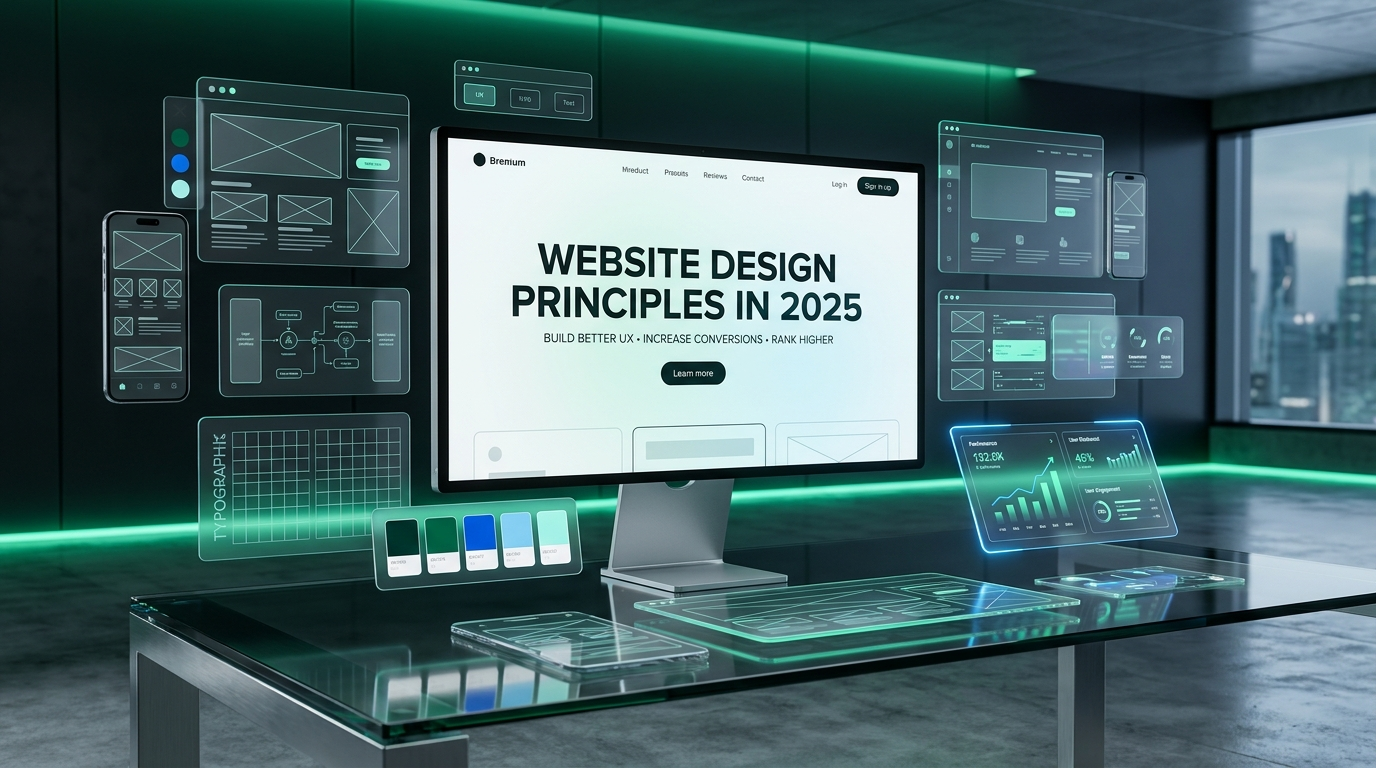
10 Website Design Principles Every Business Owner Must Know in 2025
Your website is your most powerful sales tool, yet most businesses underestimate the science behind what makes a website truly work.In 2025, users form opinions about your website in just 50 milliseconds — less time than a blink of an eye. In that fraction of a second, they decide whether to stay or leave, whether to trust your brand or seek a competitor.
This guide reveals the 10 non - negotiable website design principles that separate businesses thriving online from those invisible in the digital marketplace.These are not abstract design theories — they are battle - tested, conversion - proven principles backed by data, user psychology, and modern web standards.
Principle 1: Mobile - First Design Is Non - Negotiable
In 2025, over 63 % of all web traffic comes from mobile devices. Google uses mobile-first indexing as its primary crawling standard, meaning your mobile experience directly determines your search ranking — not your desktop site. A mobile-first design approach means designing for the smallest screen first, then progressively enhancing for larger displays.
Practical implementation: use CSS Grid and Flexbox for fluid layouts, implement touch - friendly tap targets of at least 44x44 pixels, and test your site on real devices — not just browser simulators.Frameworks like Tailwind CSS make mobile - first development systematic with responsive breakpoint utilities built into every class.
Principle 2: Visual Hierarchy Guides the Eye
Visual hierarchy is the arrangement of elements so that the most important information receives the most visual attention.Without clear hierarchy, visitors feel overwhelmed and leave.Effective hierarchy uses:
- Size contrast: Headings 3–4x larger than body text draw immediate attention.
- Color contrast: High-contrast CTAs (Call to Action) against neutral backgrounds increase click-through rates by up to 35%.
- Whitespace: Strategic use of empty space frames important elements and reduces cognitive load.
- Typography weight: Bold keywords and sub-headings create scannable content structures that retain readers.
Principle 3: Page Speed Is a Design Requirement
Page speed is no longer a technical consideration — it is a design requirement.Google's Core Web Vitals make speed a direct ranking factor. The three key metrics are: Largest Contentful Paint (LCP) which should be under 2.5 seconds, Interaction to Next Paint (INP) which should be under 200ms, and Cumulative Layout Shift (CLS) which should be below 0.1.
Design decisions that directly impact these metrics include image sizing and format choices(use WebP / AVIF), font loading strategies(use next / font or font - display: swap), the presence of render - blocking scripts, and animation complexity.Every design decision is simultaneously a performance decision.
Principle 4: Consistent Brand Identity Builds Trust
Brand consistency across your website creates professional credibility and unconscious trust.Users who encounter inconsistent fonts, conflicting color palettes, or mismatched tone assume unprofessionalism and often equate it with untrustworthiness.Define and religiously follow:
- A primary brand color palette of 2–3 colors maximum
- A typographic system: one heading font, one body font, clear size hierarchy
- Consistent icon style(all outline, all filled, or all illustrated — never mixed)
- A unified photography style: either real photos, illustrations, or 3D renders
- Consistent component patterns(cards, buttons, forms all styled uniformly)
Principle 5: The F - Pattern and Z - Pattern of Reading
Eye - tracking studies consistently show that users scan web pages in predictable patterns.Text - heavy pages are scanned in an F - pattern — across the top, down the left side, with brief horizontal scans further down. Visual pages with multiple elements are scanned in a Z-pattern — across the top, diagonally to the lower left, then across the bottom.
Place your most critical information(headline, key benefit, CTA) in the top - left quadrant for text pages.For visual landing pages, place your headline top - left, supporting visual top - right, secondary content bottom - left, and your CTA bottom - right — perfectly aligned with the Z - pattern.
Principle 6: Navigation Should Be Invisible
Great navigation is navigation that users never think about.It works so intuitively that visitors find what they need without effort.In 2025, navigation best practices include: limiting top - level navigation items to 5–7 choices(cognitive limit), using descriptive labels not clever ones, implementing breadcrumbs for content - rich sites, and ensuring consistent navigation placement across all pages.
Principle 7: Trust Signals Are Design Elements
Trust is earned visually before a single word is read.Design elements that signal trust include:
- SSL security badges and HTTPS padlock in the browser bar
- Client logos and case study thumbnails in prominent positions
- Real team photographs on About pages (versus stock photos)
- Review platforms badges (Google Reviews, Trustpilot) with dynamic star ratings
- Certifications and awards positioned near conversion points
- Media mentions (As featured in Forbes, TechCrunch) in your hero section
Principle 8: Accessibility Is Good Design
Web accessibility(WCAG 2.2 compliance) is not just a legal requirement in many jurisdictions — it is good design that benefits all users.Accessible design improves SEO(semantic HTML helps search engines understand content structure), expands your addressable market(over 1 billion people have disabilities globally), and often results in cleaner, more usable interfaces for everyone.
Key accessibility design requirements: color contrast ratio of 4.5: 1 for normal text, keyboard navigability for all interactive elements, descriptive alt text for all images, and properly labeled form inputs.
Principle 9: Conversion - Optimized CTAs
Your Call - to - Action(CTA) is where design converts to revenue.The difference between a 2 % and 8 % conversion rate on a CTA is often purely design - driven.High - converting CTAs use:
- Action verbs that communicate clear value: "Start My Free Trial" outperforms "Submit" by 300 %.
- High - contrast colors that stand out from the page without clashing.
- Sufficient size: minimum 44px height on mobile, prominent enough to be the clear next step.
- Urgency or specificity: "Get My Free Quote in 24 Hours" versus "Contact Us".
- Consistent placement: above the fold, end of sections, and at logical decision points in the user journey.
Principle 10: Data - Driven Iteration
The best website design is never "finished." It is continuously refined based on real user data.Implement Google Analytics 4 and a heatmap tool(Hotjar or Microsoft Clarity) from day one.Track scroll depth, click patterns, session recordings, and funnel drop - off rates.A / B test headline variations, CTA colors, and layout changes systematically.Design decisions informed by data outperform intuition - driven design every time.
Frequently Asked Questions About Website Design
How much does professional website design cost in 2025 ?
Professional website design ranges from $3,000 for simple brochure sites to $50,000 + for complex e - commerce or SaaS platforms.The cost reflects the strategic value: a well - designed website generating 5x more leads pays for itself within months.
Should I use a website builder or hire a professional designer ?
Website builders like Webflow or Squarespace suit small businesses with simple needs and limited budgets.For businesses serious about SEO performance, custom functionality, and brand differentiation, a professional design agency delivers compounding returns that template builders cannot match.
Transform Your Website Into a Revenue - Generating Machine
Our design team applies every principle in this guide to create websites that do not just look great — they convert.From conversion rate optimization audits to full - scale redesigns, we help businesses turn their website into their strongest marketing asset.
Book a free website audit today and discover exactly what design changes would generate the most measurable business impact for your specific goals.