Mobile App vs Web App: Which One Does Your Business Actually Need?
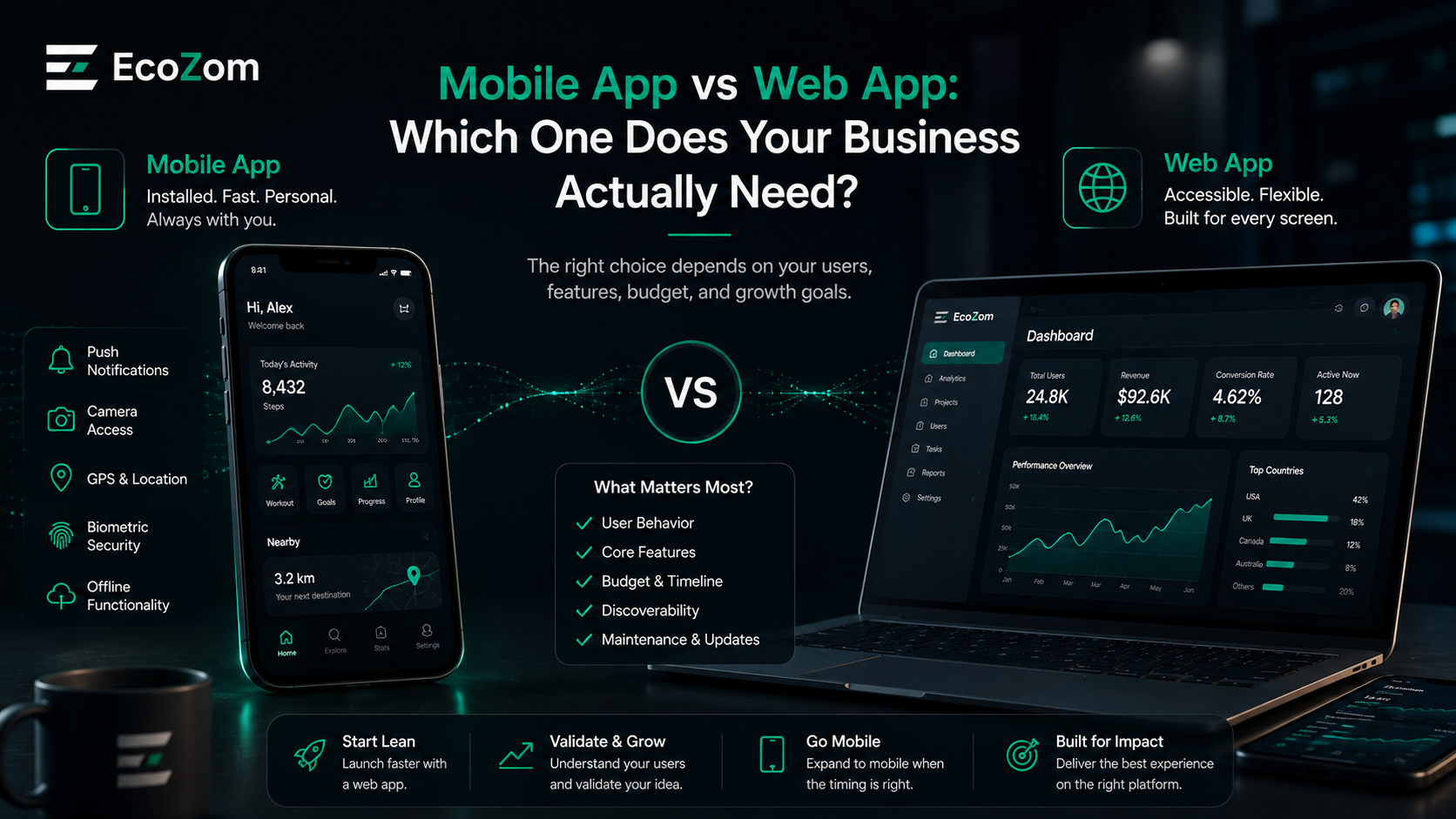
Mobile App vs Web App: Which One Does Your Business Actually Need?
One of the most common questions we hear from founders and business owners early in the product planning process is: should we build a mobile app or a web app? It sounds like a simple question, but the answer has long-lasting implications for your budget, timeline, audience, and growth strategy.
There is no single right answer. The best decision depends on what your users need, how they behave, and what your business is trying to achieve. At EcoZom, we help businesses make this call with clarity and confidence — backed by strategy, not guesswork.
Understanding the Difference
What Is a Web App?
A web app is a software application that runs in a browser. Users access it through a URL — no download, no installation, no app store required. Web apps can be made responsive and work across all devices, including desktops, tablets, and phones. Examples include platforms like Notion, Figma, and most SaaS dashboards.
What Is a Mobile App?
A mobile app is a native or cross-platform application installed directly on a smartphone or tablet. It lives on the user's home screen, can access device hardware like the camera, GPS, and push notifications, and is distributed through the App Store or Google Play. Examples include Instagram, WhatsApp, and Uber.
Key Factors to Consider
1. Who Are Your Users?
If your target audience uses your product primarily on the go — commuting, in the field, or on the move — a mobile app makes sense. If your users are primarily sitting at a desk, working in a browser, or managing complex workflows, a web app may serve them better. Understanding user behavior before making this decision is non-negotiable.
2. What Features Do You Need?
Some features are only possible or significantly better on native mobile apps:
- Push notifications to re-engage users
- Camera and media access for real-time capture
- GPS and location services for mapping and delivery apps
- Biometric authentication like Face ID or fingerprint login
- Offline functionality without internet access
If your core product requires any of these, a mobile app is the right direction. If your product is primarily data-driven, form-heavy, or management-oriented, a web app covers everything you need at a fraction of the cost and timeline.
3. Budget and Timeline
Building a native mobile app — separately for iOS and Android — is significantly more expensive and time-consuming than building a web app. Cross-platform solutions like React Native or Flutter reduce this gap, but there is still more complexity involved. Web apps generally move faster from concept to launch and are easier to update and maintain without requiring users to manually update from an app store.
4. Distribution and Discoverability
Web apps are accessible via search engines and can be found through SEO. Anyone with a link can access them immediately. Mobile apps require users to search an app store, download the app, create an account, and then engage — this is a much higher barrier to entry. However, once installed, mobile apps benefit from home screen presence and push notifications, which drive significantly higher retention.
5. Maintenance and Updates
Web apps can be updated instantly without any user action. Mobile apps require a submission and review process through app stores, which can take days. For products that need to move fast and iterate quickly, this matters.
When to Choose a Web App
- You are launching an MVP and need speed to market
- Your users are primarily desktop or laptop users
- Your product is SaaS, a dashboard, or a management tool
- Budget is a key constraint in the early stage
- You want to reach users without requiring a download
- SEO and organic discoverability are part of your growth strategy
When to Choose a Mobile App
- Your product relies on real-time location, camera, or notifications
- Your users are primarily mobile-first and on the go
- You need offline functionality
- You are building a consumer product with high daily engagement goals
- App store presence and brand visibility on home screens matter to your strategy
- You are in an industry where apps are the expected standard (fitness, delivery, social)
The Third Option: Build Both Strategically
Many successful products start with a web app for speed and validation, then add a mobile app once user behavior and product-market fit are confirmed. This staged approach reduces risk, saves budget, and ensures you are building the mobile experience for users who have already shown they value the product.
At EcoZom, we often recommend this path for early-stage products. Build lean, validate fast, then invest in the mobile layer when the business case is proven.
Our Approach to Both
Whether we are building a web app or a mobile app, our process prioritizes the same things: clean architecture, strong performance, intuitive UX, and scalable code. We use modern technologies — Next.js and React for web, React Native for mobile — ensuring that the knowledge, components, and design systems built for one can extend naturally into the other.
Conclusion
The right choice between a mobile app and a web app is not about what is more impressive — it is about what serves your users best and supports your business goals most efficiently. Take the time to understand your audience, define your must-have features, and align on budget and timeline. Make the decision from a place of clarity, not assumption.
At EcoZom, we are here to help you navigate exactly this kind of decision — with honesty, strategy, and a deep understanding of what it takes to build digital products that grow.